
Pressure injuries, often referred to as bedsores, are more than just a clinical challenge; they’re a topic that truly deserves hospitals’ attention. Each year in the U.S., over 2.5 million patients experience hospital-acquired pressure injuries (HAPIs), leading to an extraordinary $26.8 billion in preventable healthcare costs. It’s a staggering number, but with the proper focus and strategies, hospitals can significantly reduce both patient harm and financial waste.
While many pressure injuries may start small, a portion can progress to more severe stages, necessitating surgery, advanced imaging, and longer hospital stays. These severe wounds not only affect the comfort and well-being of patients but also strain hospital resources, extend patients’ time in care, and lessen bed availability for new admissions. It’s a challenge that impacts everyone.
Furthermore, it’s important to note that hospitals risk losing part of their Medicare funding if they have an excessive number of preventable injuries, such as pressure ulcers. These days, government payment structures are often linked to safety and quality metrics, emphasizing the need for improvement in this area.
HAPIs are not just about individual patient care; they also carry significant financial implications for healthcare institutions. They can lead to decreased revenues and additional operational burdens. Hospitals must focus on quality improvement strategies not only to enhance patient care but also to ensure fiscal health.
A widely cited study by Padula and Delarmente (2019) estimates that the costs associated with HAPIs could reach up to $26.8 billion annually in the United States. This figure reflects the national burden, but the study also breaks down the costs involved, helping to understand where these expenses originate.
| HAPI Stage | Estimated Daily Cost |
| Stage 1 | $418 |
| Stage 2 (Day 1-2) | $418 |
| Stage 2 (Day 3-4) | $3,256 |
| Stage 3&4 – Standard Care (Day1) | $5,464 |
| Stage 3&4 – Standard Care (Day 2-6) | $3,277 |
| Stage 3&4 – Enhanced Care (Day1) | $38,528 |
| Stage 3&4 – Enhanced Care (Day 2-14) | $5,464 |
*This table is based on cost data from Padula and Delarmente (2019) and has been recreated and simplified for clarity.
- Stage 1 and Early Stage 2: These initial stages primarily involve basic wound care and nursing support, with daily costs hovering around $418 per patient. Expenses during this phase encompass standard dressings, staff time dedicated to skin monitoring, and necessary patient repositioning. Although relatively low-cost, early intervention in these stages is crucial for preventing further progression.
- Late Stage 2: If an injury persists beyond the first 48 hours, care becomes more intensive. From Day 3 to Day 4 of Stage 2, daily costs can leap to around $3,256, reflecting the higher demands of prolonged hospital stays, more complex wound care, and diagnostic assessments.
- Stage 3 and 4 – Standard Care: For patients navigating these advanced stages, which involve significant tissue loss, standard care often requires procedures such as debridement and wound management. Initial treatment on Day 1 can cost about $5,464, with the daily expense decreasing to $3,277 from Day 2 onward for continued care and hospital stay.
- Stage 3 and 4 – Enhanced Care: In more complex cases requiring advanced imaging, surgical procedures, pathology, and extended treatment, costs can skyrocket to $38,528 on the first day. While only a small fraction of patients fall into this category, they account for a significant portion of hospital expenditures related to HAPIs.
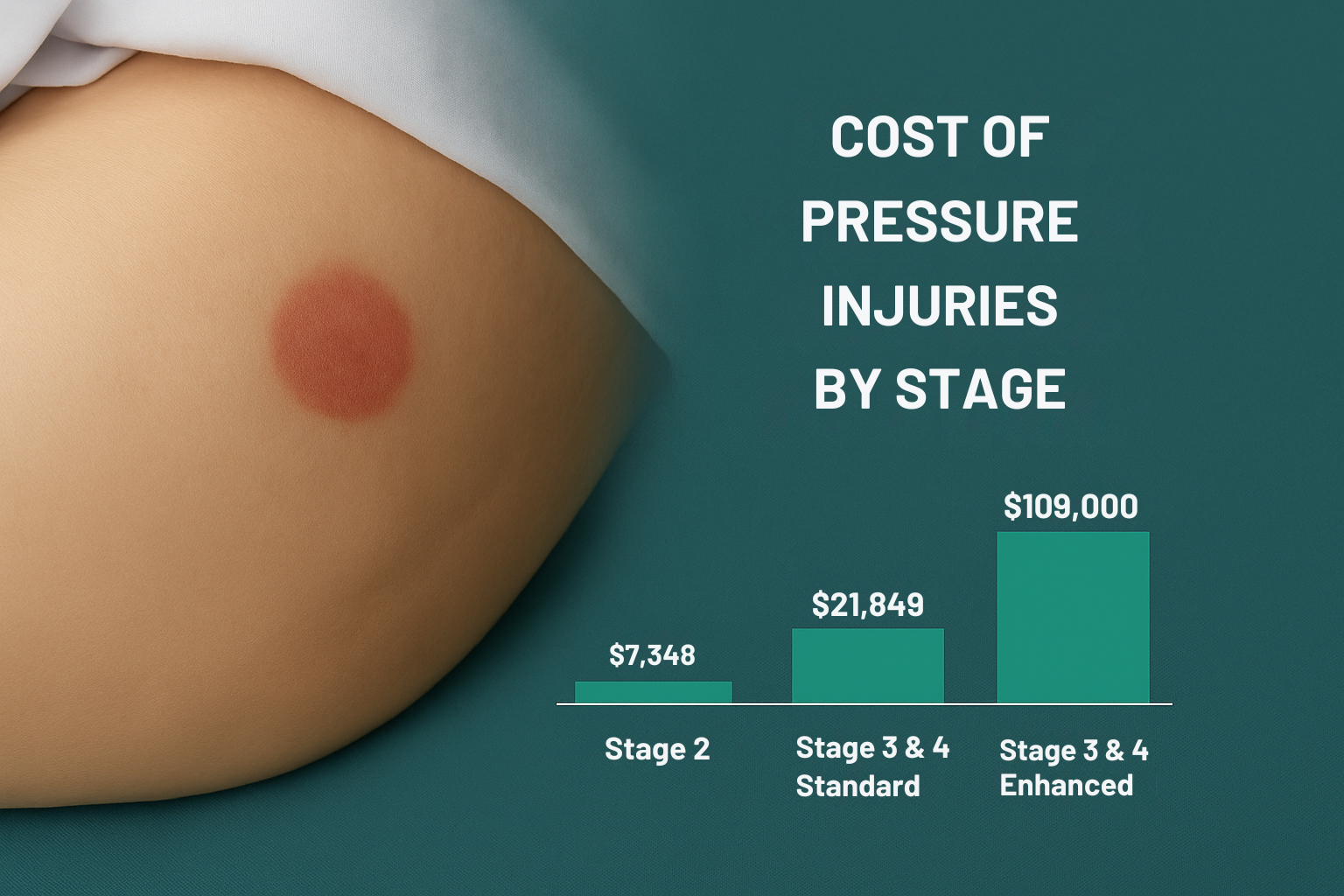
To illustrate the financial impact, consider this: if a patient stays one day at Stage 1, the cost is a manageable $418. However, for Stage 2 patients who require four days of care, the total cost rises to approximately $7,348. For Standard Care at Stage 3 or 4, a six-day treatment can result in costs of approximately $21,849. The most severe cases, which require enhanced care over two weeks, can cost over $109,000 per patient.
It’s essential to recognize that while a small percentage of patients develop advanced-stage injuries, they account for a disproportionate share of HAPI-related costs. Just the top 8% of HAPI patients can drive more than half of a hospital’s total expenditures on pressure injuries.
Given the sharp increase in costs associated with pressure injury progression, it’s clear that early intervention is not only the most caring strategy but also the most cost-effective. The study by Padula and Delarmente (2019) suggests that it can be cost-saving for hospitals to spend up to five times more than usual on Stage 1 prevention efforts as long as that investment reduces a patient’s risk of advancing to Stage 2 by at least 50%.
Moreover, this strategic approach applies to Stage 2 as well. Allocating 1.8 times the typical Stage 2 cost remains financially prudent if it reduces the likelihood of reaching dangerous stages by half.
The key message here is that prioritizing the prevention of pressure injuries is not only a matter of good patient care but also a wise financial decision for hospitals. As the severity of these injuries increases, the associated costs escalate significantly. By directing resources towards early-stage interventions, healthcare facilities can prevent the costly consequences of advanced pressure injuries, thereby safeguarding patient health and alleviating the financial pressure that HAPIs impose on the healthcare system.
Citation
Padula WV, Delarmente BA. The national cost of hospital-acquired pressure injuries in the United States. Int Wound J. 2019; 16: 634–640. https://doi.org/10.1111/iwj.13071
Leave a Reply